


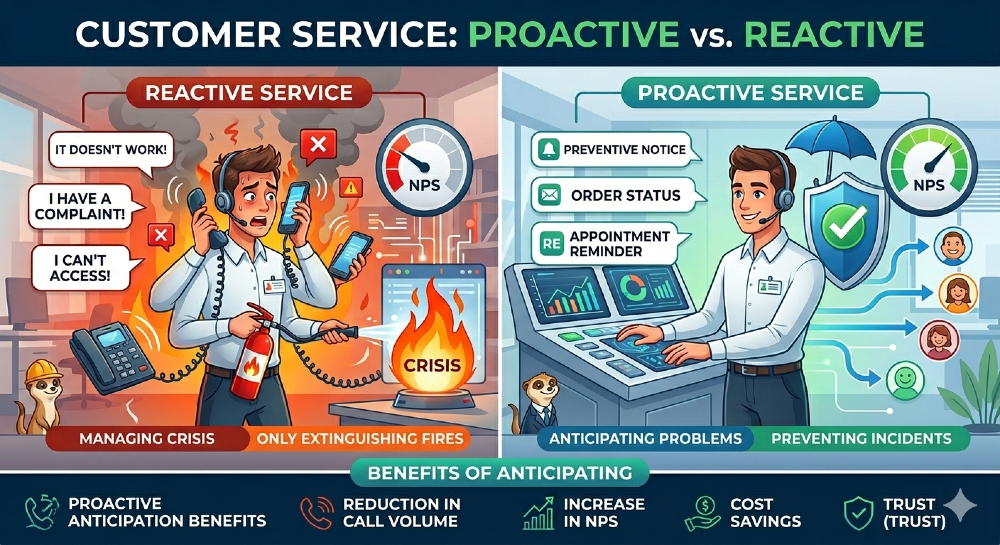
This represents a paradigm shift from “putting out fires” to “preventing sparks”.
Traditionally, customer service has been reactive: we wait for the phone to ring or for a complaint message to arrive before taking action. However, in the age of immediacy, the best service is not the one that responds the fastest, but the one that prevents customers from having to ask in the first place.
Let’s take a closer look at this concept.
1. What is proactive customer service?
It is a company’s ability to take the initiative and communicate with customers before they encounter a problem.
? Reactive: The customer calls because their service is down.
? Proactive: The company detects an outage and sends a mass notification informing customers of the maintenance window and the estimated restoration time.
2. How do we put it into practice? (the Data-Driven Strategy)
To be proactive, we need information to work in our favor.
? Pattern identification: If reports show that many customers call with billing questions on the 5th of every month, we can send an explanatory message on the 4th.
? Automated alerts: Set up automatic notifications for critical situations, such as overdue payments, order status changes, or appointment reminders.
? Radical transparency: If a technical issue occurs, communicate it immediately. Proactive honesty generates far more loyalty than reactive silence.
3. The benefits of staying ahead
Moving toward this model not only improves brand perception but also optimizes the entire operation because:
✅ Reduced call volume: Fewer incoming calls regarding basic inquiries, allowing agents to focus on more complex cases.
✅ Higher NPS scores: Customers feel valued and recognized by the company.
✅ Cost savings: Preventing a crisis is significantly less expensive than managing a wave of complaints and potential customer churn.
✅ Increased trust: Proactivity demonstrates control, reliability, and professionalism.
Conclusion: the future is predictive
Evolving from a “call center” that simply handles complaints into a “customer retention center” that actively nurtures relationships is the definitive step toward delivering an exceptional customer experience.
At Meerkat, we can help you implement these strategies. If you would like to learn more about our Omnichannel solution, Meerkat Cx 3.0, please do not hesitate to contact us.
Diego Cúneo
Director de Meerkat Media & PR LAB
Periodista y comunicador con una trayectoria de más de 30 años en medios de comunicación masiva de primer nivel. Especialista en Comunicación Corporativa, Relaciones Públicas e Institucionales, con amplia labor en grandes empresas.