


Table of Contents
- 1. Andina Link 2026: leaders in telecommunications
- 2. Event dates and location
- 3. Organization and objectives of Andina Link 2026
- 4. Participation and expected attendees
- 5. Smart Cities Expo: Urban innovations
- 6. Specialized courses and workshops
- 7. Economic and social impact in the region
- 8. Final Thoughts on Andinalink 2026
- 9. Transform Your Customer Experience with Suricata Cx
Andina Link 2026: leaders in telecommunications
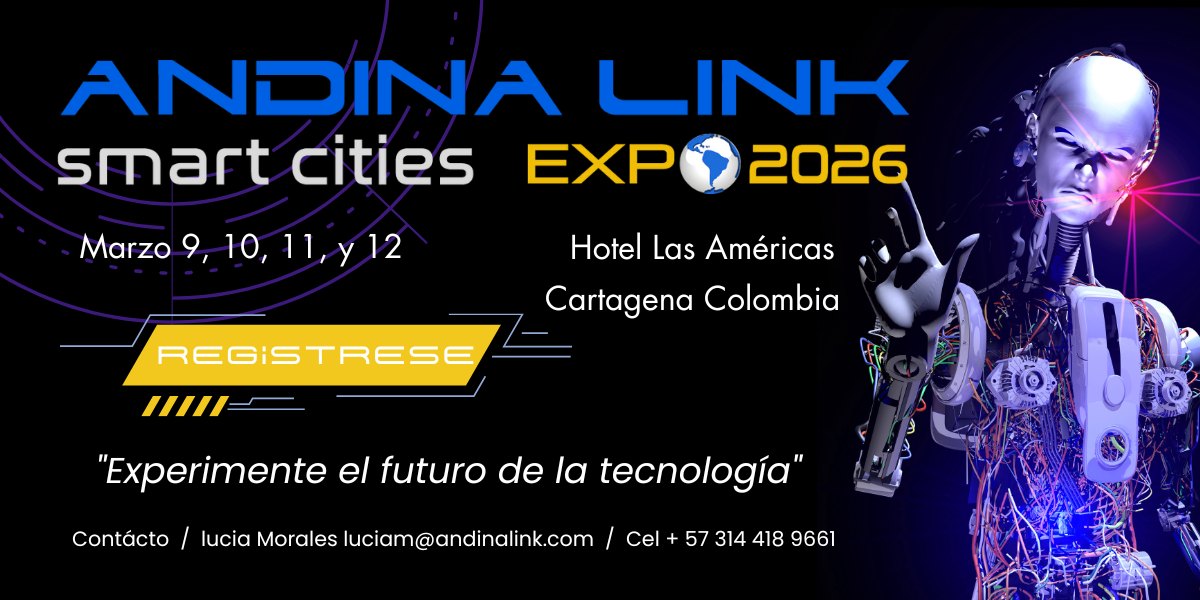
- It will take place from March 9 to 12, 2026 in Cartagena, Colombia.
- It will be hosted at the Hotel Las Américas and will bring together stakeholders in telecommunications, ICT, and convergent technologies.
- The agenda focuses on innovation, business, and networking, with an emphasis on broadband, IoT, and digital transformation.
- The Smart Cities Expo will be one of the main pillars, featuring solutions for mobility, energy efficiency, and digital inclusion.
Andina Link 2026 in Cartagena
– Dates and city: March 9–12, 2026, Cartagena (Colombia).
– Venue: Hotel Las Américas (Cartagena).
– Organizer: TDC Events International.
– Scale reported by the event: +200 exhibitors and ~6,000 attendees.
– Reported international reach: participation from +30 countries.
Sources (according to the dossier): Andina Link official website (andinalink.com) and sector event listings (e.g., Eventseye; AgileTV; CryptoGuard AB).
Event dates and location
Andina Link 2026 will be held in Cartagena, Colombia, a city that in recent years has established itself as a host for high-profile regional gatherings. In a venue that typically brings together the trade exhibition, academic sessions, and business meetings in the same space, a format that facilitates exchange among suppliers, operators, authorities, and entrepreneurs.
The four-day schedule is consistent with the event’s ambition: it is not just a technology fair, but a platform to review trends and close deals in a sector where the pace of change is constant. At the center of the conversation will be telecommunications, convergent technologies, and innovations for smart cities, with an explicit emphasis on topics such as broadband, IoT (Internet of Things), artificial intelligence, and digital transformation.
The choice of Cartagena also aligns with the meeting’s economic component: the arrival of international visitors usually has a direct impact on tourism and hospitality, two sectors that benefit from the flow of attendees, exhibitors, and delegations. In logistical terms, the single venue helps make networking more organic: corridors, halls, and exhibition areas become meeting points where technical profiles and decision-makers intersect.
Essential details of the 2026 event
Key data for planning (according to the dossier, compiled 2026-01-29):
– When: March 9–12, 2026 (4 days).
– Where: Cartagena, Colombia.
– Venue: Hotel Las Américas.
– What to confirm before traveling: day-by-day agenda, accreditation hours, and registration requirements (they may be adjusted close to the date on the official website).
Organization and objectives of Andina Link 2026
The organization of Andina Link 2026 is handled by TDC Events International, responsible for an event that boasts more than three decades of history as an annual industry gathering. That continuity explains part of its relevance: Andina Link has positioned itself as a point where industry leaders, government representatives, and technology innovators converge to discuss the present and future of connectivity in Latin America.
The core objectives, according to the event’s orientation, can be summarized in three main lines. The first is to foster innovation, showcasing advances in telecommunications, broadband, IoT, and solutions linked to smart cities. The second is to facilitate negotiations, a key component in a market where suppliers, operators, and integrators seek partnerships and concrete deployments. The third is to create networking opportunities with regional and international reach, leveraging the presence of players from multiple countries.
In practice, this combination turns Andina Link into a meeting point between strategy and operations: from discussions on sustainability and digitalization to conversations about implementation and adoption of technologies. The event also aligns with global priorities such as digital inclusion and the search for solutions to urban challenges, a framework that reinforces its relevance beyond the pure telecom sector.
In addition, the gathering serves as a barometer of two tensions running through the region: on the one hand, the need to close the digital divide; on the other, the demand that innovation be sustainable and environmentally responsible. At that intersection, Andina Link seeks to position itself as a space for exchange and coordination between industry and public policy.
Turning objectives into value
How to translate the event’s objectives into value (quick guide for attendees):
1) Innovation → actionable learning
– What to look for: demos with architecture/roadmap, use cases under real conditions (coverage, latency, energy, operations).
2) Business → agreements and pilots
– What to prepare: 1–2 prioritized problems (e.g., expansFTTH, support automation, urban IoT) + success criteria (time, cost, KPI).
3) Networking → relationships that execute
– What to prioritize: meetings with decision-makers (operations/regulation/finance) and implementation partners (integrators, vendors, ISPs) to lock in “who does what” after the event.
Participation and expected attendees
Andina Link 2026 anticipates a significant scale: participation of more than 200 exhibitors and around 6,000 attendees is expected, figures that place it among the largest gatherings in the region in telecommunications and convergent technologies. The diversity of profiles is part of the appeal: the event brings together decision-makers from government, private companies, and startups, as well as technical professionals and executives from the ICT ecosystem.
The international dimension is also a distinctive feature. The presence of participants from more than 30 countries is anticipated, which increases the value of networking: it’s not only about local contacts, but also opportunities to explore cross-border alliances, compare regulatory approaches, and meet suppliers with experience in other markets. In a sector where interoperability and standards matter, that mix of origins often accelerates conversations about best practices.
As for the composition of the exhibition floor, the event attracts a broad range of players: ISPs (Internet service providers), ICT corporations, and startups. That combination tends to generate an interesting dialogue across scales: from solutions ready for massive deployments to emerging proposals seeking partners or pilots. The presence of government representatives and public policy officials adds an additional layer, because it connects technological innovation with adoption frameworks, inclusion, and urban planning.
Beyond the numbers, the value of attending is often measured by the quality of interactions: one-on-one meetings, conversations around use cases, and the possibility of identifying trends that will impact investments in connectivity, digitalization, and urban services.
| Metric / feature | What is expected (according to the dossier) | Why it matters for the attendee |
|---|---|---|
| Exhibitors | +200 | More options to compare suppliers, integrators, and solutions in a single trip. |
| Attendees | ~6,000 | Greater networking density and a higher likelihood of finding peers/partners. |
| Countries represented | +30 | Contacts for regional partnerships and comparison of approaches (operation/regulation/standards). |
| Typical profiles | Government, corporations, startups, ICT technicians and executives | Enables conversations ranging from public policy to implementation and operation. |
| Sectors on the show floor | ISPs, ICT corporations, startups | Mix of mature solutions and proposals for pilots. |
Smart Cities Expo: Urban innovations
The Smart Cities Expo is one of the central components of Andina Link 2026 and focuses on how to integrate technology into urban planning and development. Its orientation is practical: to present solutions and approaches to challenges that cities face on a daily basis, with an emphasis on urban mobility, energy efficiency and digital inclusion.
Interest in this track is no coincidence. The conversation about smart cities often serves as a point of convergence between telecommunications, IoT and public management: without robust connectivity and without digital capabilities, many of the promises of “smart city” remain conceptual. That is why this space becomes relevant for operators, integrators and authorities seeking to translate innovation into concrete services for citizens.
The expo is backed by international organizations such as the Smart City Council and the Fiber Broadband Association, support that reinforces its global reach and its connection with technical agendas and infrastructure deployment. In terms of content, the event is expected to highlight trends linked to sustainable technologies, artificial intelligence and digital transformation, in line with the growing pressure to modernize urban services without losing sight of environmental impact.
In the background is a cross-cutting objective: to use technology to improve quality of life and reduce inequalities in access. In Latin America, where the digital divide remains a challenge, the discussion about smart cities becomes inseparable from the question of who gets connected, with what quality and under what conditions.
From the urban challenge to deployment
From the urban challenge to deployment (how to bring a “smart city” initiative into event conversations):
1) Define the challenge (1 sentence + metric): e.g., reduce travel times, lower energy losses, expand digital access.
2) Choose the use case: mobility/energy/security/citizen services/inclusion.
3) Map enablers: connectivity (fiber/wireless), IoT/sensonetworks, data platform, analytics/AI, operations.
4) Design pilot (8–12 weeks): limited scope, owners, minimum viable integration, success criteria.
5) Scaling checkpoint: operating costs, maintenance, cybersecurity, data governance, and who will fund/operate at 12–24 months.
Specialized courses and workshops
Andina Link 2026 is not limited to the exhibition and business meetings: it includes a academic and professional development component through specialized courses and workshops. The proposal aims to update knowledge in a rapidly evolving sector, where concepts such as IoT, automation, artificial intelligence, and digital transformation shift from trend to operational requirement in a short time.
A distinctive element is the possibility of accessing internationally recognized certifications, which turns the event into a training platform with a direct impact on attendees’ professional trajectory. For technical profiles, these spaces are often an opportunity to go deeper into methodologies, implementation frameworks, and discussions on the state of the art. For management profiles, they can serve as a way to align investment decisions with market trends and real capabilities.
The academic sessions also function as a forum to discuss research and trends in telecommunications and smart-city technologies. In a regional context shaped by the digital divide and the need for more robust infrastructure, these spaces can help set priorities: which technologies are mature, which require pilots, and what conditions—technical or institutional—are needed to scale.
In parallel, the workshop format tends to encourage exchange among participants: questions, comparative experiences, and case discussions. That dynamic complements the trade-fair logic, because it makes it possible to move from “what is offered” to “how it is implemented,” a critical leap when the goal is to accelerate deployments and improve services.
Criteria for choosing courses
Checklist to choose courses/workshops (and leave with something applicable):
– Level and prerequisites: is it introductory, intermediate, or advanced? what knowledge does it assume?
– Tangible outcome: do you leave with a template, guide, lab, demo, or implementation plan?
– Certification: which entity issues it and what evidence do they provide (exam, hours, badge)?
– Applicability to your role: network operations, CX, product, regulation, smart city, etc.
– Integration with your reality: does it mention typical tools/systems (APIs, OSS/BSS, CRM, analytics)?
– Time and opportunity cost:
> Which session would you stop watching to take this workshop?
– Follow-up: is there post-event material or a contact channel for questions/pilots?
Economic and social impact in the region
The impact of Andina Link 2026 is projected on two levels: the local economic and the regional social/technological. In Cartagena, the arrival of international visitors—attendees, exhibitors, and delegations—is expected to boost sectors such as tourism and hospitality, a typical effect of multi-day events with a high concentration of participants.
But the more relevant scope lies in what happens after the event. By bringing together regional and international players, Andina Link serves as a catalyst for knowledge exchange, collaboration, and potential investments in connectivity and urban solutions. In Latin America, where structural challenges persist, the gathering puts two critical issues on the table: the digital divide and the sustainability of innovations.
In social terms, the focus on digital inclusion and smart city solutions suggests a horizon for improving quality of life if the technologies discussed translate into effective policies and deployments. The logic is clear: connectivity and digitalization can enable better services, greater access to information, and new economic opportunities. However, the regional diagnosis itself recognizes that the challenge is not only technological, but also one of adoption and reach.
On the strategic level, the event also reinforces the idea of Latin America as a space with potential to attract investment and innovation in telecommunications and smart cities. The presence of participants from multiple continents opens the door to global collaborations that accelerate the adoption of best practices and solutions proven in other contexts.
Real benefits and limits
Expected benefits vs. real limits (to assess the impact with discernment):
– Local economic spillover (tourism/hospitality) ↔ depends on occupancy, length of stays, and average spending; not all the value stays in the city.
– More connectivity and innovation projects ↔ without financing, permits, and operational capacity, many initiatives remain in pilot.
– Digital inclusion ↔ requires coverage + affordability + digital literacy; infrastructure alone does not close the gap.
– Sustainability ↔ modernizing urban services can reduce consumption, but it also increases energy and maintenance demand if not designed well.
– Public-private collaboration ↔ accelerates deployments, but requires goverclear governance (data, security, responsibilities, and continuity).
Final Thoughts on Andinalink 2026
The Importance of Innovation in Telecommunications
Andina Link 2026 arrives at a time when innovation in telecommunications is no longer a competitive luxury, but a condition for sustaining the digitalization of economies and cities. The event’s agenda—broadband, IoT, artificial intelligence, and digital transformation—reflects that reality: connectivity has become critical infrastructure for services, productivity, and social participation.
The value of the gathering lies in its ability to bring together those who design policies, those who deploy networks, and those who create solutions. That convergence helps reduce the distance between vision and execution, especially when the region faces the persistent challenge of the digital divide and the need for sustainable innovations.
Opportunities for Regional Growth
The presence of attendees from more than 30 countries and the weight of the Smart Cities Expo point to a clear opportunity: turning exchange into concrete projects, partnerships, and adoption of technologies that improve urban services and expand digital access. In that sense, Andina Link operates as a marketplace of ideas and, at the same time, as a space for negotiation.
If the event manages to drive collaborations and steer investments toward connectivity and inclusion, its impact can transcend the four days of programming in Cartagena. The region needs solutions that scale and respond to social priorities; gatherings like this can accelerate that process by connecting stakeholders, capabilities, and objectives.
Transform Your Customer Experience with Suricata Cx
The Definitive Solution for ISPs and Telecommunications Operators
Suricata Cx is an AI-powered omnichannel customer experience platform, designed specifically for ISPs and telecommunications operators in the Americas and Spain. Its approach is not that of a generic chatbot: it is positioned as a CX operating system geared toward real industry workflows, integrating automation, agent assistance, and connection with operating systems.
Leverage Artificial Intelligence to Optimize Your Operations
The offering combines conversational AI, automation, and human-in-the-loop schemes (with humans in control) to scale support, sales, and service. This makes it possible to automate repetitive inquiries—such as billingion, payments, service status, or incidents—and escalate to an agent when the case requires it, maintaining traceability and supervisory control.
A customer-centric approach that reduces costs and improves satisfaction
In telecommunications, academic research and industry benchmarks often point to recurring problems: high cost per interaction, long response and resolution times, channel fragmentation, low first-contact resolution, and churn associated with poor experiences. Suricata Cx addresses these points structurally with applied automation and agent assistance, aiming to reduce friction and improve service consistency.
Scalability and efficiency: the future of customer service
Suricata Cx incorporates integration capabilities (API-first architecture and real-time synchronization) and omnichannel operation across channels such as WhatsApp, webchat, social media, and IVR/voice, with a unified view for agents and managers. In addition, it adds operational intelligence with metrics such as response and resolution times, and SLA-based management by contact reason.
Join the omnichannel experience revolution
The hybrid approach—automating what’s predictable and preserving human judgment where it matters—seeks to scale quality without proportionally scaling the team. For ISPs and operators with high contact volumes and a focus on growth, an omnichannel CX architecture with applied AI can become a competitive advantage: greater operational efficiency, a better experience, and a stronger ability to sustain expansion.
It’s the kind of space where the conversation about broadband, IoT, and digital transformation lands in real operations, especially when customer experience defines competitiveness. From that perspective, Suricata Cx offers a practical view of how to scale omnichannel support with AI and human control, reducing friction and improving response times for ISPs and operators.
From idea to operation
Typical implementation (from “idea” to measurable operation) in ISPs/operators:
1) Discovery (1–2 weeks): top contact reasons, channels, SLAs, systems (CRM/OSS/BSS), and operational risks.
2) Minimum viable integration: authentication, status/outage lookup, billing/payments (by priority) via APIs.
3) Controlled pilot (4–8 weeks): 1–2 journeys (e.g., “incident” and “payment”), with human-in-the-loop and escalation rules.
4) Quality checkpoint: containment rate, FCR, TTR, CSAT/NPS (if applicable), and audit of conversations to adjust intents and handoffs.
5) Scaling: add channels and use cases; standardize playbooks; continuous monitoring by contact reason and SLA compliance.
This article was prepared from a perspective centered on telecommunications operations and omnichannel CX (Suricata Cx), prioritizing the elements of the event that usually directly impact deployments, integration, and service scalability.