


Table of Contents
- 1. Ford Pro AI simplifies fleet management
- 2. Introduction to Ford Pro AI
- 3. Features of the Ford Pro AI chatbot
- 4. Benefits for fleet managers
- 5. How the telematics system works
- 6. Service integration and accessibility
- 7. Challenges and considerations in adoption
- 8. Implications in the commercial fleet market
- 9. Conclusions on Ford Pro AI for fleet management
Ford Pro AI simplifies fleet management
AI assistant for fleets
– What it is: a generative AI chatbot integrated into Ford Pro Telematics to help fleet managers query and summarize operational information.
– What data it uses: vehicle telemetry (e.g., speed, seat belt use, engine health) to turn signals into recommendations and tasks.
– What it can do today: answer questions in natural language, suggest actions (e.g., fuel savings), and draft emails with summaries.
– Who it’s for: it’s designed for fleet managers who already use the telematics subscription; it’s not aimed at drivers.
– How it’s controlled: it operates in “read-only” mode and keeps a person “in the loop” to execute decisions.
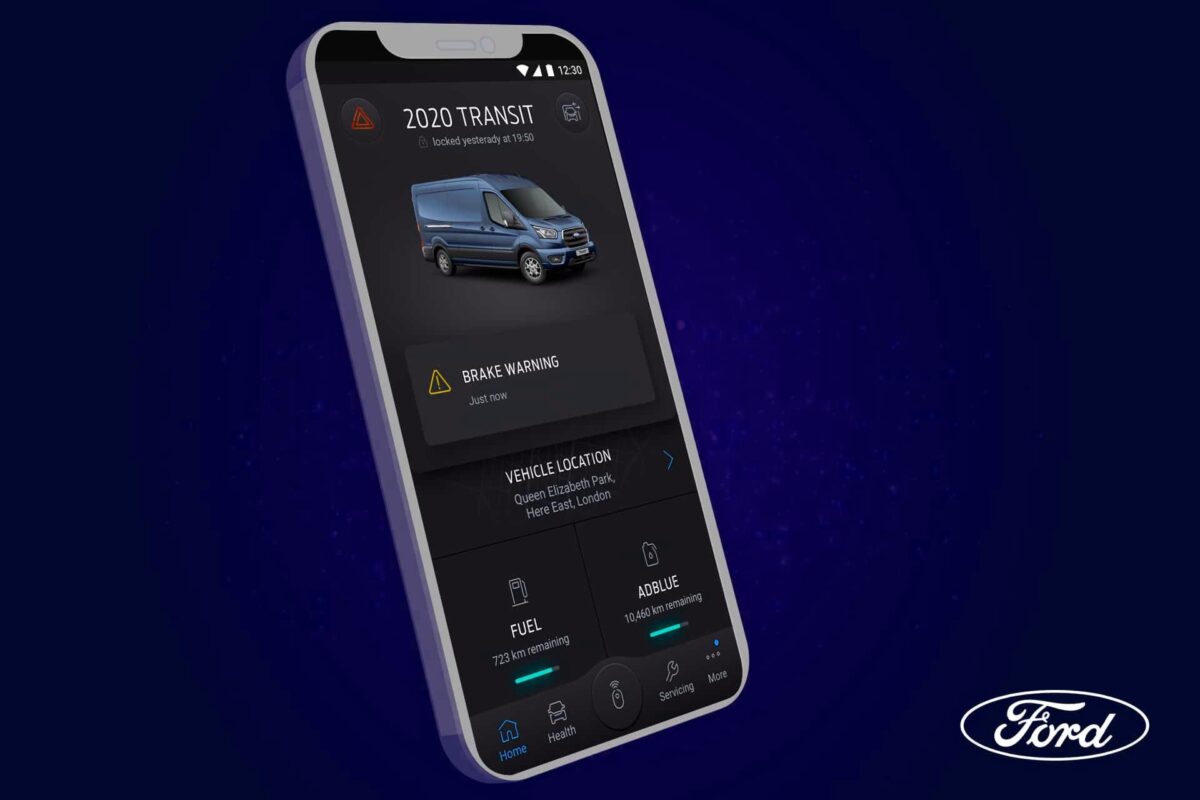
- Ford launched Ford Pro AI, a generative AI chatbot integrated into its Ford Pro Telematics software for commercial fleet customers.
- The tool analyzes vehicle data (such as speed, seat belt use, and engine health) and turns it into actions and recommendations.
- It enables natural-language queries and can even draft emails with summaries for supervisors.
- It is included at no additional cost for telematics subscribers and works with vehicles from different brands if they transmit data via built-in modems.
- Ford says it operates with “manufacturer-grade” data and an architecture designed to reduce hallucinations, keeping a person “in the loop” to execute decisions.
Introduction to Ford Pro AI
Ford is bringing the wave of artificial intelligence to the less flashy—but more profitable—side of mobility: commercial fleet management. The company announced Ford Pro AI, a conversational assistant integrated into Ford Pro Telematics that promises to turn the constant stream of telemetry into concrete tasks for those who manage work vehicles.
The goal is clear: reduce friction in a role that combines operational pressure, mechanical urgencies, and daily data-driven decisions. Ford is targeting its more than 840,000 paying subscribers to its telematics platform, with a proposition that doesn’t require switching vehicle brands to benefit.
Features of the Ford Pro AI chatbot
Analysis of data generated by
commercial vehicles
The core of the system is the ability to process operational data that connected vehicles already collect and turn it into actionable information. Examples cited by Ford include:
- Vehicle speed
- Seat belt activity
- Engine health and diagnostic signals
From that set, the chatbot can answer questions about the status of a specific unit, detect patterns, and help prioritize actions, such as maintenance or adjustments to contain costs.
Natural language interface
Ford Pro AI is presented as a chatbot within the telematics software, with an experience similar to popular assistants like ChatGPT or Gemini, although Ford did not reveal which specific model it uses and it was described as “model-agnostic”.
In practice, the fleet manager can:
- Ask for recommendations to reduce fuel consumption
- Request insights on specific vehicles
- Delegate communication tasks, such as drafting an email to a supervisor with a summary of findings and next steps
| Function | Data used (examples) | Outcome for the fleet manager |
|---|---|---|
| Unit status queries | Engine health, diagnostic signals | Quick answers about which vehicle requires attention and why |
| Operational recommendations | Speed, usage patterns, consumption/efficiency (depending on available telemetry) | Suggestions to contain costs (e.g., fuel) and prioritize actions |
| Pattern and exception detection | Repeated events in the fleet (e.g., alerts, habits) | Identification of “what keeps repeating” and where it makes sense to intervene first |
| Summaries and communication | Results of previous queries + fleet context | Email drafts or summaries for supervisors/teams |
| Natural language interaction | User questions + fleet-structured data | Less time navigating dashboards; more focus on decisions |
Benefits for fleet managers
Time savings in fleet management
Theits main promise is to cut the time spent on repetitive tasks: checking dashboards, cross-referencing reports, looking for exceptions, and turning metrics into messages for other teams. Ford Pro AI aims to act as a “translation” layer between telemetry and decisions, automating part of the analysis and synthesis work.
Ford frames it as a response to job burnout: fleet management, according to the company, is a “high-friction” job where the administrative burden can contribute to exhaustion. Along those lines, Britta Farrow, Ford Pro communications manager, said the assistant can take on “operational data processing — what burns out fleet managers —,” although it “definitely still requires human intervention.”
Operational agility with telemetry
– Less time on reports: when the chatbot answers in natural language and produces summaries, the manager avoids some of the “copy/paste” between dashboards, spreadsheets, and emails.
– Faster prioritization: by turning signals (e.g., diagnostics) into an action list, it reduces the time spent deciding “what comes first” in maintenance or inspection.
– More consistent communication: email drafts help standardize how findings and next steps are reported to supervisors or other areas.
– Less operational friction: the value shows up especially on days with many exceptions (alerts, units with faults, consumption spikes), where synthesizing information is often the bottleneck.
– Key condition: results depend on the quality/coverage of telemetry available in the fleet and on the team adopting the conversational workflow.
Improving operational efficiency
By centralizing questions and answers in a conversational interface, the system aims to speed up decisions that directly impact:
- Fuel costs, through operational recommendations
- Vehicle availability, by highlighting vehicle health signals
- Action prioritization, by turning scattered data into task lists
Ford maintains that using “clean” and fleet-structured data helps make the answers more reliable than those of a generic chatbot.
How the telematics system works
Ford Pro AI relies on the Ford Pro Telematics infrastructure, which receives data from connected vehicles. The company indicated that the tool can work not only with Ford vehicles: also with any vehicle that has an integrated modem capable of transmitting information to the platform.
As for the AI, Ford explained that the system usesa multi-agent architecture built on Google Cloud. According to Kevin Dunbar, general manager of Ford Pro Intelligence, the design aims to reduce the risk of “hallucinations” by relying on high-quality OEM data and fleet-specific information.
From telemetry to decisions
1) Vehicle (on the road) → generates telemetry (e.g., speed, seatbelt events, engine diagnostics).
2) Built-in modem → transmits the data to the platform (if there is connectivity and the vehicle is configured to report).
3) Ford Pro Telematics → organizes the information by fleet (customer-structured data).
4) Ford Pro AI (chat) → the manager asks in natural language; the system queries that fleet’s data and assembles an answer.
5) Actionable output → recommendations, task lists, or communication drafts.
6) Human checkpoint → in “read-only” mode, the system does not execute on its own: the manager validates and decides what gets implemented.
Service integration and accessibility
Ford Pro AI is integrated within the existing subscription to Ford Pro Telematics.
Access, for now, is limited to those who manage fleets from the software. Ford noted that there are no current plans to offer it to commercial drivers via the mobile app or the vehicle’s software.
In addition, the system operates in “read-only” mode: it can analyze, suggest, and draft, but certain actions will still require human execution.
| Includes (today) | Does not include (for now) | Practical limits to consider |
|---|---|---|
| Access from within the Ford Pro Telematics environment | Access for drivers via mobile app or onboard software | If the operations team doesn’t use Telematics daily, adoption may be slower |
| Recommendations and answers based on fleet telemetry | Automatic execution of actions (operates in read-only) | Requires human validation before acting; useful for control and traceability |
| Drafting of summaries/emails | Public confirmation of the specific LLM model | Ford says it is “model-agnostic”; behavior may evolve over time |
| Support for multi-brand fleets (ifthere are modems and data) | Guaranteed identical coverage for all third-party vehicles | The quality of recommendations may vary depending on the available data coverage |
Scope and limits confirmed by Ford
- AI model: Ford did not reveal which specific model it uses; it described it as “model-agnostic”.
- Infrastructure: the company indicated that it is built on Google Cloud.
- Action execution: the assistant can help with analysis and drafts, but requires human intervention to carry out certain tasks.
- Availability: it is aimed at Ford Pro Telematics subscribers and, for now, only for fleet managers.
Challenges and considerations in adoption
Adopting an AI assistant in critical operations does not depend only on novelty. Ford Pro AI faces foreseeable challenges:
- Trust: fleet managers need consistency; an incorrect recommendation can translate into costs, downtime, or wrong operational decisions.
- Data quality and coverage: the system’s performance will depend on the available telemetry and its integration, especially in mixed fleets with vehicles from different manufacturers.
- Habit change: moving from traditional dashboards and reports to a conversational flow requires adjustments in internal processes and in how decisions are documented.
Ford tries to anticipate these frictions with its emphasis on “manufacturer-grade” data, multi-agent architecture, and read-only operation.
Key risks and mitigations
– Risk: unreliable recommendations → Mitigation: start with low-risk use cases (summaries, prioritization) and require the chat to cite the data/vehicle/event that led it to that conclusion.
– Risk: incomplete data in multi-brand fleets → Mitigation: map which vehicles report which signals (diagnostics, consumption, events) before “trusting” comparisons.
– Risk: automating communication without context → Mitigation: use drafts as a base, but review assumptions (dates, owners, severity) before sending.
– Risk: dependence on the conversational flow → Mitigation: maintain a minimal verification process in the dashboard (2–3 checks) for decisions that affect availability or costs.
Implications in the commercial fleet market
The move reinforces a trend: manufacturers no longer compete only on vehicles, but on software, subscriptions, and services. By including Ford Pro AI at no additional cost, Ford increases the perceived value of its platform and seeks to consolidate its position in a market where telematics and analytics have become differentiators.
There is also a competitive angle: by supporting non-Ford vehicles, the company positions itself as a management provider for real-world fleets—often multi-brand—and not just as a closed ecosystem. In a sector where downtime is costly, the promise of turning data into actions with less effort can sway software purchasing decisions, even above the vehicle brand.
Integrated AI for mixed fleets
– Business model (subscription): by adding “included” AI, telematics becomes more “sticky” (more daily use) and harder to replace.
– Multi-brand strategy: supporting non-Ford vehicles expands the target market and fits the operational reality of many mixed fleets.
– Competitive advantage: the differentiator is not just the chat, but the combination of vehicle data + workflow (summaries, prioritization, communication).
– Real barriers: adoption will depend on trust, data coverage, and the product remaining useful for concrete tasks (not just “answering questions”).
Conclusions on Ford Pro AI for fleet management
Impact on operational efficiency
Ford Pro AI aims to reduce administrative burden and speed up decisions by turning telemetry into recommendations, summaries, and tasks. If it delivers on accuracy and usefulness, it can become an everyday tool to improve costs and vehicle availability.
Challenges in technology adoption
The key will be trust: the AI must demonstrate consistency, clearly explain its conclusions, and adapt to heterogeneous data in mixed fleets. The decision to keep a human in the loop and operate in read-only mode suggests Ford is prioritizing control and gradual rollout.
Future outlook for fleet management
The integration of conversational assistants into telematics foreshadows a future where the fleet manager “asks” and the system “orchestrates” information, reports, and next steps. In that scenario, value will shift increasingly toward platforms capable of combining connectivity, high-quality data, and practical automation.
AI readiness for fleets
– Confirm who will have access (managers only) and which decisions
will remain 100% human.
– Review which telemetry signals are available per vehicle (especially in multi-brand fleets).
– Define 2–3 initial use cases (e.g., weekly summaries, maintenance prioritization, consumption analysis).
– Establish a verification step before acting (which dashboard/data validates the recommendation).
– Measure impact with simple indicators: report preparation time, units with alerts addressed on time, and reduction of “back-and-forth” via email.
Transform your customer experience with Suricata Cx
Leverage artificial intelligence to optimize your support
Suricata Cx applies AI to turn support interactions into faster, more consistent responses, reducing wait times and improving the customer experience.
Process automation for greater efficiency
Automating repetitive tasks—classification, routing, initial responses, and summaries—frees teams to focus on complex, higher-impact cases.
Improve customer retention with exceptional service
Agile, contextual support, with clear follow-up and proactive communication, helps reduce friction and sustain long-term relationships.
Scalability and control in your operations
Suricata Cx makes it possible to scale service without losing operational visibility, with metrics and flows that make it easier to maintain quality standards.
Seamless integration with your existing infrastructure
The proposal focuses on integrating with tools already used by the organization, to accelerate adoption and maximize value without unnecessary redesigns.
Gradual support optimization
1) Diagnosis: identify the 5–10 most frequent contact reasons and where the most time is lost (classification, context search, drafting).
2) Initial automation: enable suggested replies, summaries, and routing for those high-volume reasons.
3) Quality checkpoint: review a sample of conversations (accuracy, tone, resolution) and adjust rules/templates.
4) Operational metrics: track first response time, resolution time, and recontact rate.
5) Iteration: expand to new flows only when the previous ones are stable and the team trusts the outcome.
Ford Pro AI: chatbot for fleet managers shows how aconversational assistant, supported by telemetry, can turn operational data into faster, more communicable decisions. At Suricata Cx we share that same philosophy applied to critical operations: practical AI, integrated into real workflows and with human control to sustain trust and consistency.
This text is based on publicly announced information about Ford Pro AI and its integration with Ford Pro Telematics as of the time of writing. Availability, regional scope, and implementation details may vary by customer and change over time. If you are evaluating the tool, it is advisable to validate what is promised with a trial in your fleet and with the telemetry actually available.