


Table of Contents
- 1. TL;DR: Impact of Conversational AI Voicebots on Businesses
- 2. Introduction to Conversational AI and Voicebots
- 3. Value of the conversational AI platform software market
- 4. Definition of Conversational AI Voicebot
- 5. Key technologies in AI Voicebots
- 6. How an AI Voicebot Works
TL;DR: Impact of Conversational AI Voicebots on Businesses
- 24/7 availability: Voicebots offer continuous customer service, improving accessibility.
- Reduction in operating costs: Implementing voicebots can decrease the need for human staff, saving costs.
- Improved customer service: Fast and accurate responses increase customer satisfaction.
- Transformation of customer service: Voicebots are revolutionizing how companies interact with customers.
- Growth outlook: The voicebot market is expected to grow significantly in the coming years.
Introduction to Conversational AI and Voicebots
Conversational artificial intelligence (AI) has emerged as a crucial tool in the business sphere, transforming the way organizations interact with their customers. Voicebots, an application of this technology, enable companies to offer more efficient and accessible customer service. As consumer expectations evolve, the need for solutions that provide fast and accurate responses becomes essential.
Voicebots use advanced technologies such as automatic speech recognition (ASR), natural language processing (NLP), and text-to-speech (TTS) to interact with users in a way similar to how a human would. This not only improves the customer experience, but also optimizes companies’ internal processes.
With a conversational AI platform software market expected to reach $589.76 million by 2031, it is clear that the adoption of voicebots is a growing trend that businesses cannot ignore. This article will explore in depth how voicebots are impacting businesses, their benefits, how they work, and the key technologies that underpin them.
Value of the conversational AI platform software market
The value of the conversational AI platform software market has grown exponentially in recent years. In 2024, the market was estimated to be valued at approximately $234.82 million, and this figure is expected to double by 2031. This growth is driven by increasing demand for solutions that improve the customer experience and optimize operational efficiency.
Companies are investing in voice technology to automate processes, reduce costs, and improve customer satisfaction. Implementing voicebots allows organizacione
to offer 24/7 support, which is crucial in a world where consumers expect immediate responses. In addition, the use of AI in customer service not only improves efficiency, but also allows companies to collect valuable data about customer interactions, which can be used to further improve services.
| Year | Market value (millions of dollars) |
|---|---|
| 2024 | 234.82 |
| 2025 | 300 (estimate) |
| 2031 | 589.76 |
- Table showing the projected growth of the conversational AI platform software market.
Definition of Conversational AI Voicebot
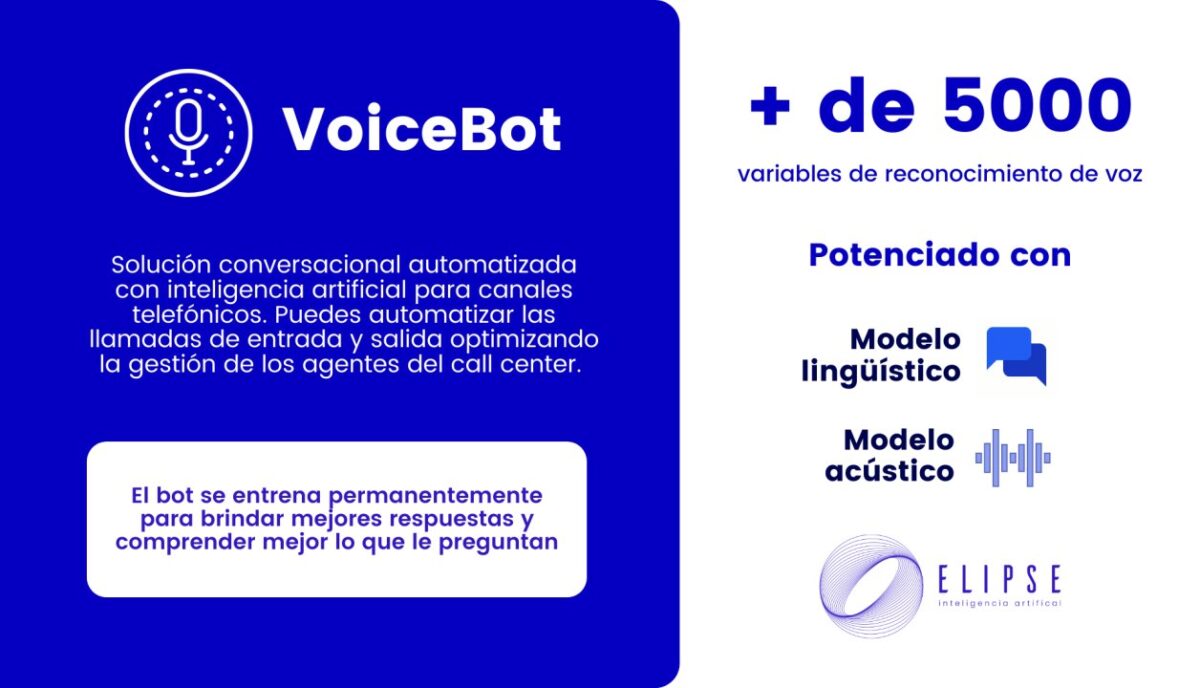
A conversational AI voicebot is an application powered by artificial intelligence that interacts with users through voice commands. It uses technologies such as ASR to transcribe speech into text, NLP to understand the context of queries, and TTS to generate responses in the form of speech. This combination of technologies allows voicebots to simulate a human conversation, offering a more natural and fluid experience for the user.
Voicebots are used in various applications, from customer service to sales assistance, and are especially valuable in environments where speed and efficiency are essential. For example, companies like Domino’s Pizza have implemented voicebots to take orders, which not only improves the customer experience, but also reduces the workload of human staff.
Key technologies in AI Voicebots
The technologies that underpin voicebots are fundamental to their operation and effectiveness. The main technologies involved are described below:
Automatic Speech Recognition (ASR)
ASR converts speech into text, allowing the voicebot to understand users’ queries. This technology is crucial for verbal interaction, as it enables users to communicate naturally without needing to type.
Natural Language Processing (NLP)
NLP enables voicebots to understand the context and intent behind the user’s words. This is essential for providing relevant and accurate responses, thereby improving the quality of the interaction.
Text-to-Speech (TTS)
TTS converts the text generated by the voicebot into speech, allowing responses to be communicated audibly. This technology is what makes the interaction more human and accessible.
Machine Learning
EMachine learning enables voicebots to improve over time, learning from past interactions and adjusting their responses accordingly. This not only improves accuracy, but also makes it possible to personalize the user experience.
How an AI Voicebot Works
How an AI voicebot works can be broken down into several key steps:
User input
The process begins when a user issues a voice command. This input can be anything from a simple question to a complex request.
Speech-to-text transcription (ASR)
ASR converts the voice input into text, which is then processed by the system.
Context understanding (NLP)
NLP analyzes the transcribed text to understand the context and the user’s intent. This is crucial for providing an appropriate response.
Intent identification (NLU)
Intent identification (NLU) allows the voicebot to discern what the user really wants, extracting entities and resolving ambiguities in language.
Response generation (TTS)
Once the voicebot has understood the query, it generates a response that is converted back into speech through TTS, completing the interaction cycle.
Benefits of implementing AI Voicebots in business
Implementing AI voicebots in business offers multiple benefits that can transform the way companies interact with their customers.
Improved customer service
Voicebots can handle multiple interactions simultaneously, providing fast and accurate answers to customer inquiries. This not only improves customer satisfaction, but also reduces the workload of human staff.
Reduced operating costs
By automating repetitive tasks and enabling customers to self-serve, companies can significantly reduce operating costs. This is especially relevant in an environment where efficiency is key to profitability.
24/7 availability
Voicebots allow companies to offer continuous customer support, which is essential in a world where consumers expect immediate responses, regardless of the time of day.
Impact of Voicebots on the customer experience
Voicebots are revolutionizing the customer experience byby offering faster and more efficient interactions. Consumers value speed and convenience, and voicebots meet these expectations by providing instant and accurate responses.
In addition, voicebots’ ability to handle multiple inquiries simultaneously means customers don’t have to wait in long queues to get assistance. This not only improves customer satisfaction, but can also increase brand loyalty.
Differences Between AI Chatbots and Voicebots
Although both chatbots and voicebots use conversational AI technologies, there are key differences in their interaction methods:
| Feature | Chatbot | Voicebot |
|---|---|---|
| Communication mode | Text-based | Voice-based |
| Technology used | Mainly NLP | NLP + ASR + TTS |
| Accessibility | Requires typing | Hands-free, faster |
| Interaction speed | Slower, depending on typing speed | Faster |
| Use cases | Customer support, website chats | Smart assistants, IVR systems, outbound calls |
- Table showing the key differences between chatbots and voicebots.
Future Outlook for the AI Voicebots Market
The future of the AI voicebots market is promising, with projected growth reflecting the increasing adoption of this technology across various industries. Companies are expected to continue investing in voice solutions to improve customer experience and optimize operational efficiency.
As technology advances, voicebots will become more sophisticated, capable of handling more complex interactions and offering more personalized service. This will not only benefit companies in terms of costs and efficiency, but will also improve customer satisfaction by providing more human and natural interactions.
Conclusions on the Impact of Conversational AI Voicebots on Businesses
The Transformation of Customer Service
Voicebots are transforming the way companies interact with their customers, offering faster and more efficient service. This transformation is essential to meet consumers’ growing expectations.
Strategies for the Successful Implementation of Voicebots
To implement voicebots in an effecTo be effective, companies must consider integrating these technologies into their existing processes, ensuring that they align with their customers’ needs and business objectives.
The Future of Conversational AI in the Business Environment
As conversational AI continues to evolve, its impact on the business environment is expected to grow. Companies that adopt this technology will be better positioned to compete in an ever-changing market, offering exceptional customer experiences and optimizing their operations.
This article has explored in depth the impact of conversational AI voicebots on businesses, highlighting how they work, their benefits, and the future of the market. The adoption of this technology is not only a trend, but a necessity for companies seeking to remain competitive in an increasingly digitalized business environment.