


Table of Contents
- 1. TL;DR: 6G networks will require three times more spectrum than today
- 2. Spectrum requirements for 6G
- 3. Mobile traffic projections for 2040
- 4. Commercial deployment of 6G networks
- 5. Urban demands and required spectrum
- 6. Implications for spectrum policy
TL;DR: 6G networks will require three times more spectrum than today
- 6G networks will need between 2 and 3 GHz of mid-band spectrum per country for 2035-2040.
- Global mobile traffic is expected to reach up to 3,900 exabytes per month by 2040.
- More than 5 billion 6G connections are anticipated by 2040.
- Government planning is crucial to avoid spectrum bottlenecks.
- 5G adoption will remain essential during the transition to 6G.
Spectrum requirements for 6G
6G networks are designed to meet constantly growing data demand, which implies a significant increase in spectrum requirements. According to the GSMA report, 6G networks are estimated to need up to three times more mid-band spectrum than is currently available. This increase is crucial to support AI-driven services and advanced digital applications.
Required mid-band spectrum
For 2035-2040, a global average of between 2 and 3 GHz of mid-band spectrum per country is projected to be required. Nations with higher demand could need between 2.5 and 4 GHz. This spectrum is essential for densely populated urban areas, where network capacity becomes a critical factor.
Note: The mid-band, spanning frequencies between 1 and 6 GHz, is preferred for its balance between coverage and mobile broadband performance.
Comparison with current spectrum
Currently, the available spectrum is insufficient to meet future traffic projections. Compared with current spectrum, which does not exceed 1 GHz in many regions, the need for 2 GHz by 2030 is pressing. If this spectrum is not secured, a decline in the user experience is anticipated, with slower speeds and greater congestion.
Mobile traffic projections for 2040
Mobile traffic projections for 2040 are alarming and reveal the magnitude of the challenge facing 6G networks. Global mobile traffic is estimated to reach up to 3,900 exabytes per month, representing a significant increase compared to current figures.
Growth of global mobile traffic
Traffic growth will be driven by the continued adoption of 5G, the rise of “power” users, and new applications enabled by 6G. The 10% of mobile users, who currently generate between 60% and 70% of total traffic, are expected to increase their usage, becoming normal behavior by 2040.
Traffic by connection
It is estimated that each mobile connection will generate between 140 and 360 GB of traffic per month by 2040. This increase in data usage highlights the urgent need to ensure sufficient spectrum to avoid congestion and maintain service quality.
Commercial deployment of 6G networks
The commercial deployment of 6G networks is scheduled to begin in 2030, with significant implementations in regions such as China, Japan, South Korea, the United States, and several European and Asian countries.
Implementation timeline
The first 6G implementations are expected to begin in 2030, with an initial focus on high-demand urban areas. Deployment phases will be coordinated with spectrum planning and government decisions on band allocation.
Key regions for deployment
The regions expected to lead 6G deployment include Asia and North America, where existing infrastructure and data demand are higher. These areas will benefit from the early implementation of 6G technologies, which could give them a competitive advantage in the global digital economy.
Urban demands and required spectrum
Urban areas account for a large share of mobile traffic, which poses unique challenges for spectrum planning. The concentration of users in these areas makes network capacity a critical factor.
Spectrum needed in urban areas
The GSMA report highlights that urban areas, which represent only 5% of the global land surface, generate 83% of mobile traffic. This underscores the need for adequate spectrum to meet demand in these densely populated zones.
Impact on congestion
Without adequate spectrum allocation, an increase in network congestion is anticipated, which will negatively affect the user experience. Advance planning is essential to prevent networks from being overwhelmed by growing demand.
Implications for spectrum policy
Spectrum planning is a crucial aspect of the success of 6G networks. Governments and regulators must act quickly to secure the necessary spectrum and avoid bottlenecks in the future.
Government planning
Government planning must include the identification of suitable spectrum bands and the creation of policies that facilitate the release of spectrum for mobile use. This is especially important as they approach
key conferences such as WRC-27.
Risks of not acting
If governments do not act proactively, they could face serious consequences, such as slower speeds, increasing congestion, and missed economic opportunities. A lack of action could jeopardize the competitiveness of digital economies in the transition to 6G.
5G adoption and its impact on 6G
The adoption of 5G will play a fundamental role in the transition to 6G. The lessons learned from the implementation of 5G will influence how 6G networks are deployed and managed.
Relationship between 5G and 6G
5G and 6G are interrelated, as the infrastructure and technologies developed for 5G will lay the groundwork for evolution toward 6G. The coexistence of these technologies will be crucial to ensure a smooth transition.
New applications enabled by 6G
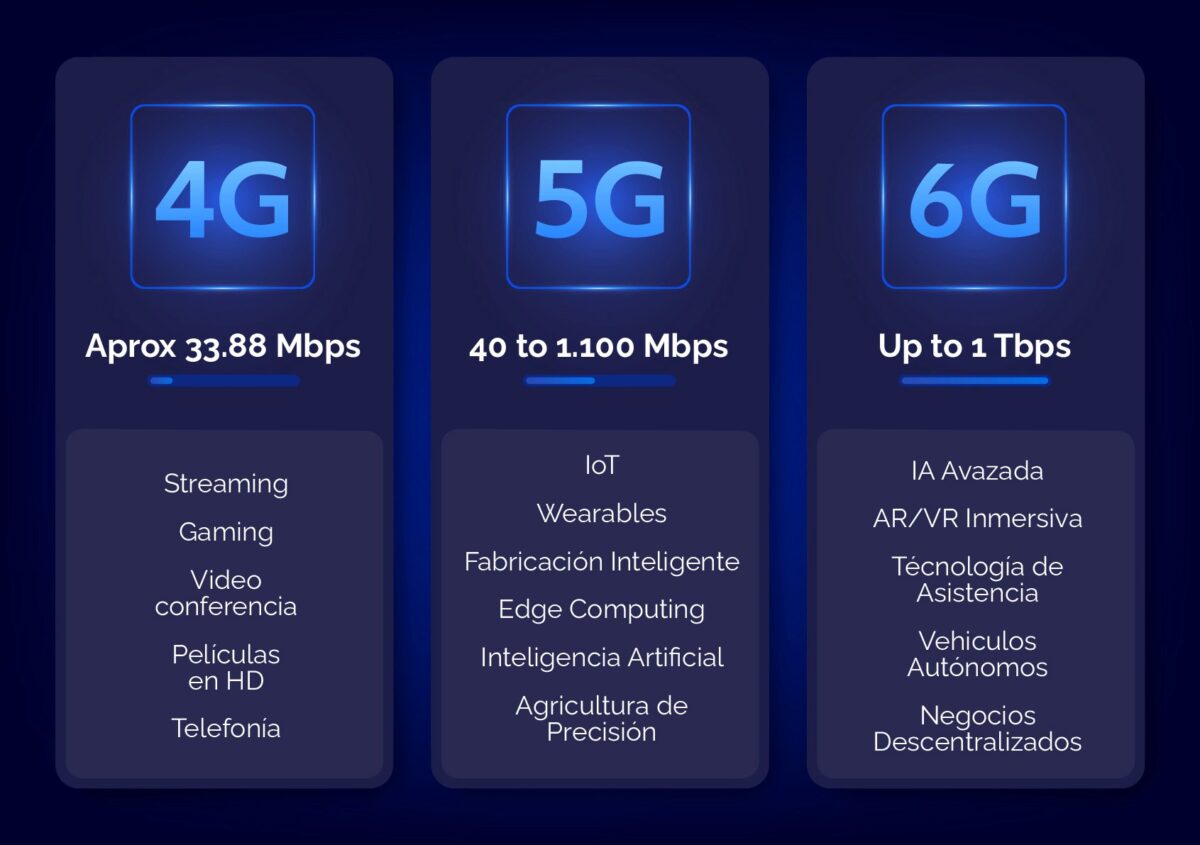
6G is expected to enable innovative applications that are not possible with current technologies. This includes autonomous systems, extended reality (XR), and integrated sensing applications, which require significant spectrum to operate effectively.
The future of 6G networks and their impact on global connectivity
The transition to 6G represents a significant opportunity to improve global connectivity. However, it also presents challenges that must be addressed urgently.
The urgent need for additional spectrum
Growing data demand and the evolution of digital technologies require additional spectrum. Proper spectrum planning and allocation are essential to avoid bottlenecks in the future.
Challenges and opportunities in implementing 6G
Implementing 6G will present technical and regulatory challenges, but it will also offer opportunities to innovate and improve connectivity. Collaboration among governments, operators, and regulators will be key to success.
The role of governments in spectrum planning
Governments play a crucial role in spectrum planning, ensuring that informed and proactive decisions are made to meet future connectivity needs.
Mobile traffic projections and their economic implications
Mobile traffic projections indicate significant growth, which will have important economic implications. Nations that do not prepare adequately could lose competitivity in the digital economy.
The importance of international collaboration in spectrum regulation
Spectrum regulation is a global challenge that requires international collaboration. Policy harmonization and cooperation between countries will be fundamental to the success of 6G networks.
This article provides a comprehensive overview of spectrum requirements for 6G networks and the implications of their implementation. Early planning and collaboration among stakeholders in the mobile ecosystem will be essential to ensure a successful transition to the next generation of connectivity.

Martin Weidemann is a specialist in digital transformation, telecommunications, and customer experience, with more than 20 years leading technology projects in fintech, ISPs, and digital services across Latin America and the U.S. He has been a founder and advisor to startups, works actively with internet operators and technology companies, and writes from practical experience, not theory. At Suricata he shares clear analysis, real cases, and field learnings on how to scale operations, improve support, and make better technology decisions.