


Measuring your own success is now a crucial tool for business growth.
In the world of customer service, there is a golden rule that should always be kept in mind: “What isn’t measured can’t be improved.” However, we sometimes get lost in a sea of acronyms and numbers, which is why it’s essential to understand which metrics truly move the needle for the business.
Here, we explain the key performance indicators (KPIs) that every service leader must monitor to ensure an exceptional customer experience (CX).
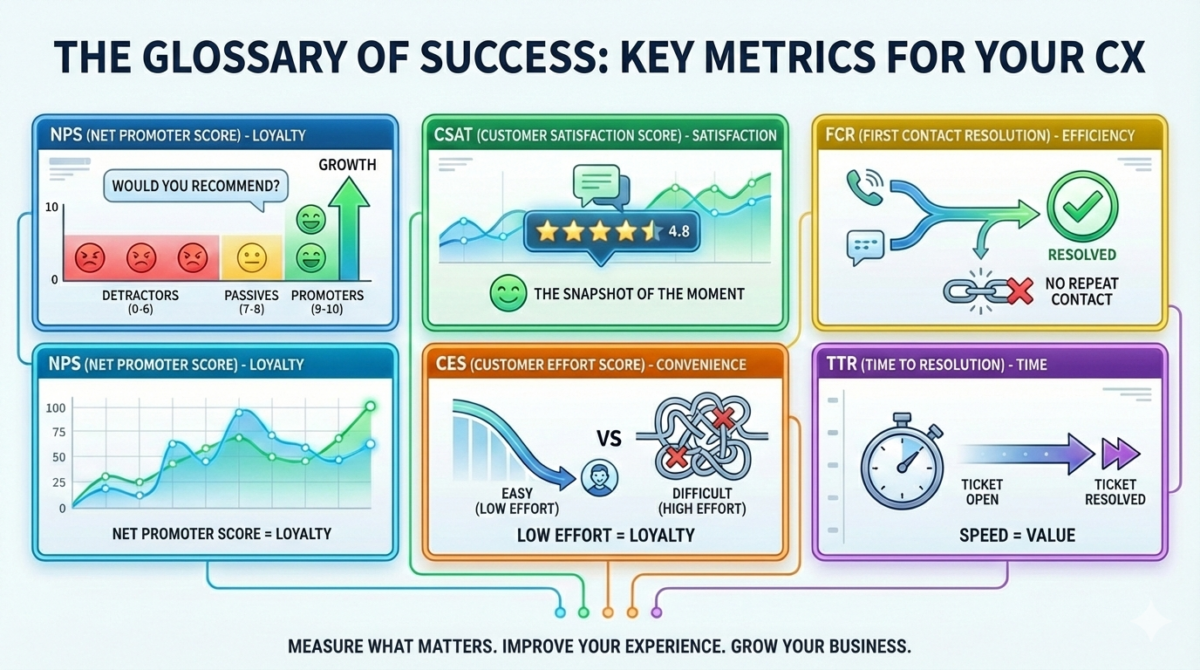
1. NPS (Net Promoter Score): the loyalty thermometer
👉 NPS measures the likelihood that a customer will recommend your company to others.
📈 How is it measured? With a single question: “On a scale from 0 to 10, how likely are you to recommend us?”
💡 Why does it matter? It segments customers into Promoters (9–10), Passives (7–8), and Detractors (0–6). It is the best predictor of long-term growth.
2. CSAT (Customer Satisfaction Score): a snapshot in time
👉 Unlike NPS, CSAT measures satisfaction after a specific interaction (a purchase or technical support).
📈 How is it measured? By asking: “How satisfied are you with the service you received today?”
💡 Why does it matter? It helps immediately identify specific issues in processes or service channels.
3. FCR (First Contact Resolution): the king of efficiency
👉 FCR measures the percentage of inquiries resolved during the first contact, without the customer needing to call or write again.
💡 Why does it matter? It has the greatest impact on satisfaction. Nothing frustrates a customer more than having to repeat the same issue multiple times. In addition, it dramatically reduces operational costs.
4. CES (Customer Effort Score): the convenience metric
👉 It measures how easy (or difficult) it was for the customer to resolve their issue.
💡 Why does it matter? Studies show that loyalty is built not only by delighting customers, but by making their lives easier. Low effort is synonymous with long-term relationships.
5. TTR (Time to Resolution): the value of time
👉 This is the total time that elapses from when a ticket is opened until it is marked as resolved.
💡 Why does it matter? In the age of immediacy, slowness is the number one enemy. Monitoring TTR allows you to identify bottlenecks within your team.
⚡ Did you know that with Meerkat Cx you can access all these metrics without the need to hire additional services, as they are built into our application? That’s why MeerkatCx3.0 is the strategic ally for your company.
✅ In this regard, Meerkat Cx 3.0 is the strategic ally for your business, as it allows you to measure all these parameters quickly and easily.
So don’t wait any longer—contact us today and we’ll help you take the next step your company needs.
Martin Weidemann is a specialist in digital transformation, telecommunications, and customer experience, with more than 20 years leading technology projects in fintech, ISPs, and digital services across Latin America and the U.S. He has been a founder and advisor to startups, works actively with internet operators and technology companies, and writes from practical experience, not theory. At Suricata he shares clear analysis, real cases, and field learnings on how to scale operations, improve support, and make better technology decisions.